You Are Viewing Art
Chiaroscuro – From Caravaggio to Harris Savides
I believe I first heard of the obscure word Chiaroscuro many many years ago as an art elective student in Victoria School – My then art teacher, a distinguished Irish gentleman named Paul O’shea, was an accomplished artist who taught the subject with such passionate fervor that Art history left a deep, lasting impression on me and continues to be a big source of inspiration for my works today. Mr O’shea also pronounced Chiaroscuro ( and Contrapposto ) beautifully; I lucidly remember my classmates and me grinning in childish pleasure every time the word escaped his lips.
Chiaroscuro, simply put, means light and darkness. In painting terms, it denotes the use of deep variations in and subtle gradations of light and shade to create the illusion of three-dimensionality, often to dramatic effect. The Baroque artist Caravaggio was a champion of Chiaroscuro, creating paintings ( Supper at Emmaus, below ) as hauntingly beautiful now as they were 400 years ago.

Yoko Tanji
I’ve been a big fan of renowned Japanese illustrator Yoko Tanji ever since I saw her work after arriving in Tokyo 3 years ago, so you can imagine how elated I was when she replied an email I wrote to her a few days back. ( considering she must receive fan mail by the hundreds everyday. )
I had learned about her latest works while visiting the blog of her friend Enrico Casarosa, ( an amazing storyboard artist from Pixar with a penchant for Japan, who was super nice to add my blog link on his. ) prompting me to write to her while in a brazen, excited state of fanboy stupor.
In her reply she remarked that she had bought Freedom 1 dvd *Yay!* and had enjoyed watching it, which understandably made this fanboy very, very happy.
Be amazed by her beautiful illustrations at http://www.tanji.jp/
Mucha Exhibition
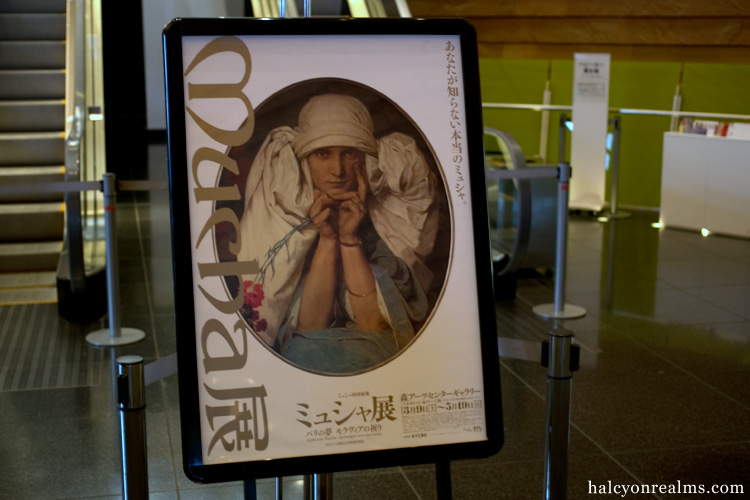
Believe me when I say that its a once in a lifetime fortuity to have been able to catch the Mucha Exhibition on at the Tokyo Metropolitan Art Museum, quite simply because 1) 100 pieces from the exhibition have never been allowed abroad till now, 2) its Mucha, champion of the Art Nouveau movement and 3)I’m his absolute, complete acolyte, right up there with Waterhouse. His advant garde illustration style was light years ahead during his era and even in recent times as countless artists feverishly copied, imitated, duplicated none ever reproduced anything as stunning as did Mucha himself. Even if anyone came close, Mucha would have beaten them a full hundred years ahead. At the end of my visit that day as I was hurried out by the curators my eyes were painfully strained having pored over every single piece of his amazing works.

PS Why are so many friends from Netherlands checking out this post ? Is there an event going on ? Please let do leave a comment and let me know why.
National Museum of Western Art, Ueno
It was only yesterday did I discover that the National Museum of Western Art in Ueno Park houses a most impressive collection of paintings running the gamut from movements like Romanticism, Post-Impressionism, Dada to Pointilism. ( Being able to recall these semantics, admittedly, credit must go to my Victoria School AEP teacher, who tormented us with lengthy essay assignments on art movements. ) Some noteworthy names included Monet, Renoir, Van Gogh, Tiepolo, Pollock, Rosetti, heck, they even had an El Greco. But certainly the highlight had to be the Delacroix ( housed in a quaint, original Delacroic frame ) even though the painting on display was a lesser known work I couldn’t remember, but standing in its presence where the master had worked his magic some 200 years ago still gives one considerable kick. Now all that’s left to do is to see Liberty Leading The People in Louvre.

Yoko Tanji Illustrations

Exhibiting palpable influences from an eclectic mix of Art Noveau, the Impressionists, Surrealists, Gustav Klimt, and manga art, Japanese illustrator Yoko Tanji’s works ellicit an unspoken feel of quiet poignance, cast in autumn shades with gloom forever lurking round the corner. With a colour palette awash in sombre, intense reds and browns, oblivious, detached characters, felicity is probably not the artist’s favourite subject.
Goodbye, Liu Kang
It was way back during my secondary school days when I first studied about the pioneer artists of Singapore in my arts theory class, a small group of talented individuals banded together by their collective passion for the visual arts. Some names that are still fresh in my mind were the late Chen Wen hsi, Chen Chong Swee, Georgette Chen, the calligrapher Pan Shou, as well as Liu Kang ( His son Liu Thai Ger is presently the chairman of NAC, the body overlooking my scholarship ) who has just passed away 2 days ago, the last of the pioneer artists.
During a Chen Wen hsi Retrospective exhibition that was held at the Singapore National Museum about 10 years ago, I had the good fortune of meeting with Mr Liu Kang personally. I remember vividly how me and my classmates caught him sipping ice-cream with his wife at the YMCA Macdonalds, where after we followed him and asked for his autograph at the exhibition. Dispite the huge age gap he was most hospitable and approachable, exhorting us in our pursuit of the arts as young individuals, just like he had done so. Although pursuing a different course in the arts now, the experience I had with him them was certainly one of the highlights of my younger school days.
Art exhibitions in Tokyo
Art exhibitions seem to be in the wind recently, this morning together with 2 taiwanese classmates I visited the Bunkamura Art Museum in Shibuya, Tokyo to view the Monet – Great Impressionists exhibition, which includes pieces by some other notable painters like Seurat, Signac, Bonnard and Renoir. While many of the artists’ greater works were not on show, ie Renoir’s “Le dejeuner des canotiers”, more commonly known as the Amelie Painting, it was exhilarating to see Monet’s Waterlilies in person.

Tokyoscape, on the way home from Shibuya.
Later at a bookstore in Shibuya, my attention is quickly drawn to a promotional movie trailer playing off a small TV, its music, mood and visual style just screaming Shunji Iwai. Hana & Alice, Iwai’s latest film. I was seized by an intense and involuntary urge to tear off the movie poster and boot, but my friends shook their heads violently in disapproval. Saddened, I was however jolted back to my senses, remembering succintly the exact purpose of my studies in Japan, the earnest passion I have for the moving image and narrative that was in a huge part, attributed to the artistic influences bore by watching Iwai’s cinematic magnum opus, Love Letter.
Meeting Patrick Stewart
Talk about uncanny serendipity. Today morning I was at the Tokyo Metropolitan Art Museum to view an exhibition on 17th century Flemish and Dutch painters, which included some works by Peter Paul Rubens, Rembrant and Vermeer. As I sat down near a resting area by the main entrance after I’ve finished, this caucasian gentleman wearing a cap and spotting a most distinctive sharp, angular nose walked by. He could have been any of those tourists around, but he wasn’t just any other tourist. This man is Captain Jean Luc Picard, commander of Starfleet Enterprise, Prof Charles Xavier, leader of the X-men.

I couldn’t believe my eyes, but I also couldn’t pass up such a good chance to get an autograph, so here you go. Mr Patrick Stewart was all friendly and courteous, an exemplary British gentleman indeed.
Defending Dark Water
I’ve been getting relatively negative reviews about the movie Dark Water whilst I was in camp. No one seems to appreciate the movie for the very cinematic elements ( set design, camera work, editing and music, sfx ) that contribute to its moody and dark atmosphere. All my campmate’s attention were pretty much centered on “only the last part was scary” or “i was only scared when those bumbs appeared on the watertank” and in the worse case, “its a lousy show !”. Suddenly I found myself a self appointed defender of the movie as I argued for its worth, as I would argue for a thousand other movies my friends all deem to be bad. Yes, i agree its a horror movie, scares are necessary, but those few scenes are what I would label as “in your face” scares and had the least impact on me.
Which brings me to the debatable point here : Are movies in general, esoteric ? That means to say that they are only intelligible to those who have special knowledge, and in this context those who have a slightly better understanding of film aesthetics. Shouldn’t a movie be crafted in such a way that the majority of the audience would be able to appreciate its elements without prior acquired knowledge ? It certainly didn’t seem to be the case here. Or perhaps movie audiences here are just so awashed by mainstream hollywood movies that their acquired tastes are conformed to certain treatment, and they quickly reject alternate or different styles of work when they see one ?
I can’t help but relate this to the art scene in the early 20th century where the Paris Salon, the most established academy that exhibits and showcases art pieces, judges entry works by a certain predetermined standard and those not conformed to those are labelled as bad or unorthodox, unrefined. It was also here that the Impressionist painters, Cezzance, Renoir and the like bear the full brunt of the criticism by been different and it was not until much later when they recieved full acclaim for the pieces.